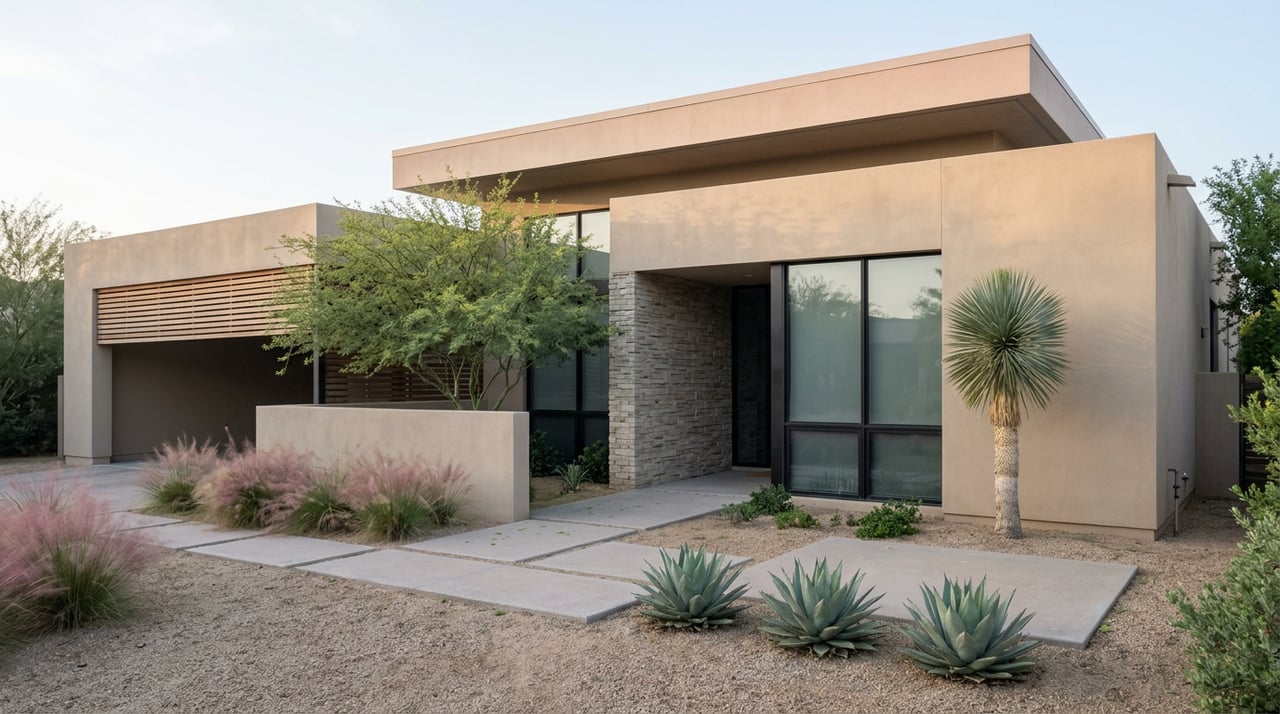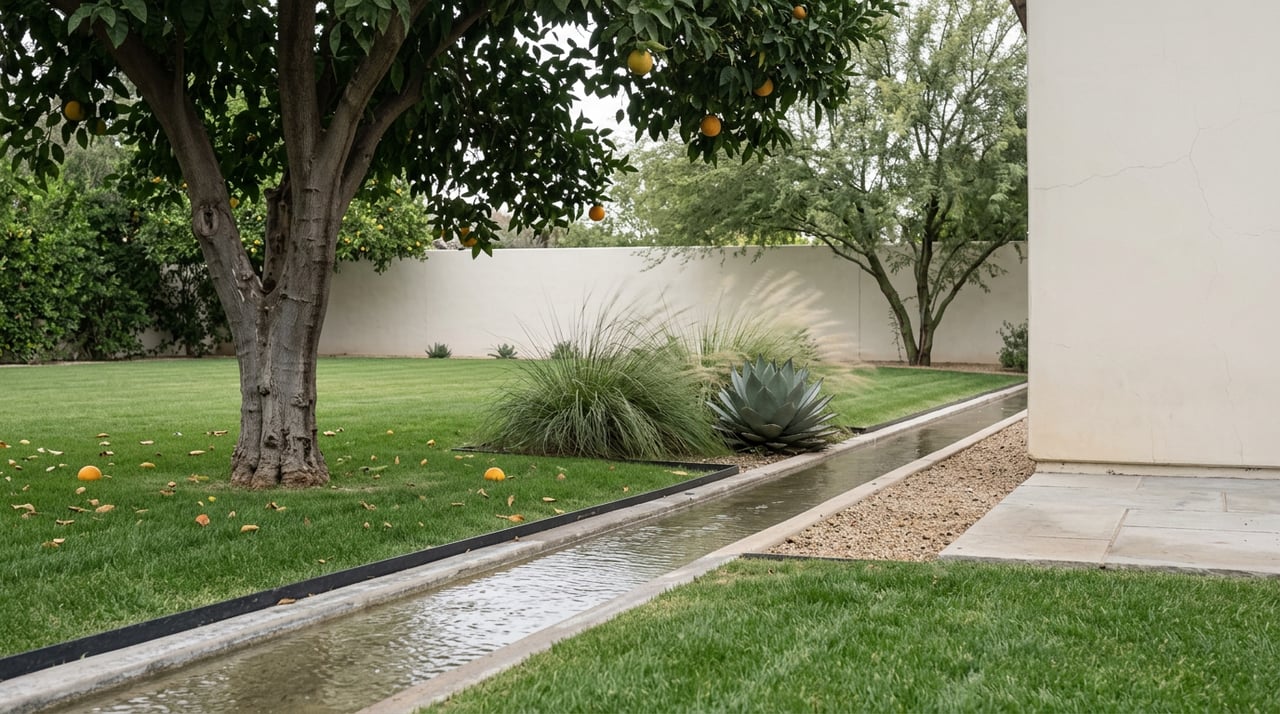
A buyer's agent calls the Salt River Project water contact center to start an irrigation account transfer ahead of a scheduled Arcadia closing. SRP has no account on file for the address. The lot is irrigated. The seller has been paying a bill for years. It just isn't SRP's bill.
This happens often enough in Arcadia that it deserves its own line item in due diligence, not a footnote. The neighborhood's signature feature, the flood-irrigated lawns and citrus canopy that mature-lot buyers pay a premium for, actually runs on two entirely separate systems that happen to share the same casual name. Most listing sheets, most agents, and most first-time Arcadia buyers say "flood irrigation" and mean SRP. Sometimes they're right. Sometimes the water has never touched an SRP canal.
One Word, Two Companies
Salt River Project irrigates most of the Valley through a canal network fed by a watershed that channels rain and snowmelt into the Salt and Verde rivers. SRP moves water through the system and its own employees, known as zanjeros, physically open delivery gates to release water toward the highest point of a neighborhood on a set schedule. Past that delivery gate, the water becomes the neighborhood's problem: SRP is explicit that the ditches, pipes, and channels from its gate to individual lots are owned, operated, and maintained by the property owners themselves.
Arcadia also has a second, older provider that never became part of SRP's canal system. The Arcadia Water Company was incorporated in 1919 as an Arizona non-profit corporation built for one purpose: getting water to the citrus groves that gave the neighborhood its name. It still exists. It still runs its own wells, its own pumping plant, its own reservoir, and its own network of main distribution lines and diversion boxes, largely independent of SRP's canal infrastructure. Landowners inside the Arcadia Water Company's service area hold their water right by virtue of owning the land, conditioned on paying the company's $100 membership fee along with whatever water, delivery, or repair charges the company assesses.
The company's footprint traces back to developer Seymour Jordan, who formed it specifically because land north of Camelback Road couldn't reach the Arizona Canal on its own. By 1924, crews had laid fifteen miles of underground concrete pipe to move that water through the new subdivision. The house that is now the Shemer Art Center and Museum was originally built in 1919 as the residence for the water company's foreman, which tells you how central the irrigation system was to Arcadia's founding, not a landscaping feature bolted on later.
Here's the comparison a buyer or seller actually needs before escrow, not after:
| Salt River Project | Arcadia Water Company | |
|---|---|---|
| Structure | Public reclamation-era water and power utility | Private non-profit, incorporated 1919 for its members only |
| Water source | Canal system fed by the Salt and Verde river watershed | Its own wells, pumping plant, and reservoir |
| Delivery control | Zanjero opens the gate on a set schedule | Company's operations manager and irrigation coordinator regulate delivery |
| Entry cost | Account setup fee, no separate membership | $100 membership fee tied to the land |
| Ongoing cost | Published, itemized annual rate schedule | Fees set by the company, not publicly itemized online |
| Who to call | SRP Water Contact Center, (602) 236-3333 | The company's own board and operations office |
Neither company is better or worse. They are simply not interchangeable, and a title report or a listing description that just says "SRP flood irrigation" without confirming which entity actually serves the parcel is passing along an assumption, not a fact.
The Last Mile Belongs to the Neighbors, Not the Utility
Even once you know which provider serves a lot, the story isn't finished. SRP stops at the delivery gate. Everything after that, the ditches, the shared pipe, the turnout box on the property line, belongs to the owners on that lateral. In practice, that means a cluster of Arcadia neighbors often functions as its own tiny, informal utility.
The Aldrich Irrigation Association is a working example of exactly that: a voluntary organization coordinating delivery for 77 homes on shared laterals, the kind of arrangement that exists all over Arcadia's older blocks without ever appearing on a listing sheet. Groups like this frequently hire a dedicated delivery contractor rather than have each homeowner open their own gate. Arizona Residential Irrigation Delivery Service publishes a typical schedule for the arrangement: about eighteen deliveries a year, roughly twice a month through the six warmer months and once a month through the six cooler ones.
That last-mile structure is the part a straightforward "who's the provider" question misses. Two houses on the same street, both served by SRP, both technically on flood irrigation, can still have completely different delivery arrangements depending on whether their lateral is self-managed or contracted out, and whether the shared infrastructure has been maintained by five cooperative neighbors or two who stopped speaking years ago.
What the Numbers Actually Say About Cost
SRP's published rate schedule for the 2027 water year, issued in March 2026, breaks the annual bill for a residential account of one acre or less into a water delivery fee of $97.34 per active account plus $0.47 per acre, and a basic charge for stored and developed water of $56.16 per acre covering the first two acre-feet of the base allocation. Additional fees only kick in if a household exceeds that allocation. SRP is explicit about why the numbers look this way: as a water rights landowner, you aren't buying water by the gallon the way a city utility customer buys tap water. The right belongs to the land, and the fees mostly cover the cost of storing, moving, and administering that water, not the water itself.
That structure is why local market practitioners who track these bills for Arcadia clients typically land on a total annual cost somewhere between $270 and $450 for a standard irrigated lot, billed in two installments. It's a modest number relative to what the same square footage of turf and mature citrus would cost to keep alive on metered city water. The Arcadia Water Company doesn't publish an equivalent rate table online, which means its members can't simply look up an estimate the way an SRP account holder can. The only reliable number for an AWC-served lot is the seller's actual billing history, which is exactly why it belongs on the request list before an offer, not after.
The Lots That Have Neither
Not every address inside Arcadia's boundaries carries an irrigation right at all. The neighborhood is generally defined as the area north of the Arizona Canal and south of Camelback Road, between 44th Street and Scottsdale Road, and within that footprint some pockets, generally smaller and more recently redeveloped parcels toward the western edge, were never tied into either the SRP canal system or the Arcadia Water Company's network. Those homes still sit inside Arcadia. They just don't have the feature that keeps a next-door lawn green through a Phoenix August without a metered water bill to match.
That absence shows up in price. A lot with an active, documented irrigation right generally commands a real premium over a comparable dry lot nearby, because that right is what sustains the mature canopy and citrus that make Arcadia's streets look the way they do from the sidewalk. The premium is legitimate. So is the ongoing responsibility that comes with it.
Before You Write the Offer
A short list, worth working through before contract rather than during the inspection period:
- Confirm which entity actually serves the parcel, SRP, the Arcadia Water Company, or neither, before assuming the listing description is accurate.
- Request the account number and at least two years of billing history from that specific provider, not a generic estimate.
- Locate the delivery gate or turnout in person and confirm it's functioning rather than simply present.
- Ask whether the lateral is managed by a voluntary group like the Aldrich Irrigation Association model, and whether that group contracts a delivery service.
- Start the account transfer or membership conveyance process before closing. SRP's transfer is a straightforward account change. An Arcadia Water Company membership tied to the land may involve a different process entirely, and the company's own office is the only reliable source for how that works on a given parcel.
FAQ
Is the water from either company safe to drink? No. Both systems deliver irrigation water for outdoor landscape use, not potable water for household use. Domestic water in Arcadia comes through the City of Phoenix's separate potable system.
What happens if a scheduled delivery day is missed? On most laterals, missing your turn means waiting for the next one on the rotation, which can be as infrequent as once a month during the cooler part of the year. That's part of why an informed buyer wants to know the actual schedule for a specific lot, not just that irrigation exists.
Arcadia's irrigation system is one of the few things in this neighborhood that can't be evaluated from a listing photo or a satellite view of the canopy. It has to be traced back to the account, the lateral, and the paperwork behind both. That kind of verification is exactly the work Artie Baxter does before a client writes an offer or accepts one. If you're buying or selling an irrigated Arcadia lot and want the irrigation history checked before it becomes a closing-week surprise, book an appointment.